
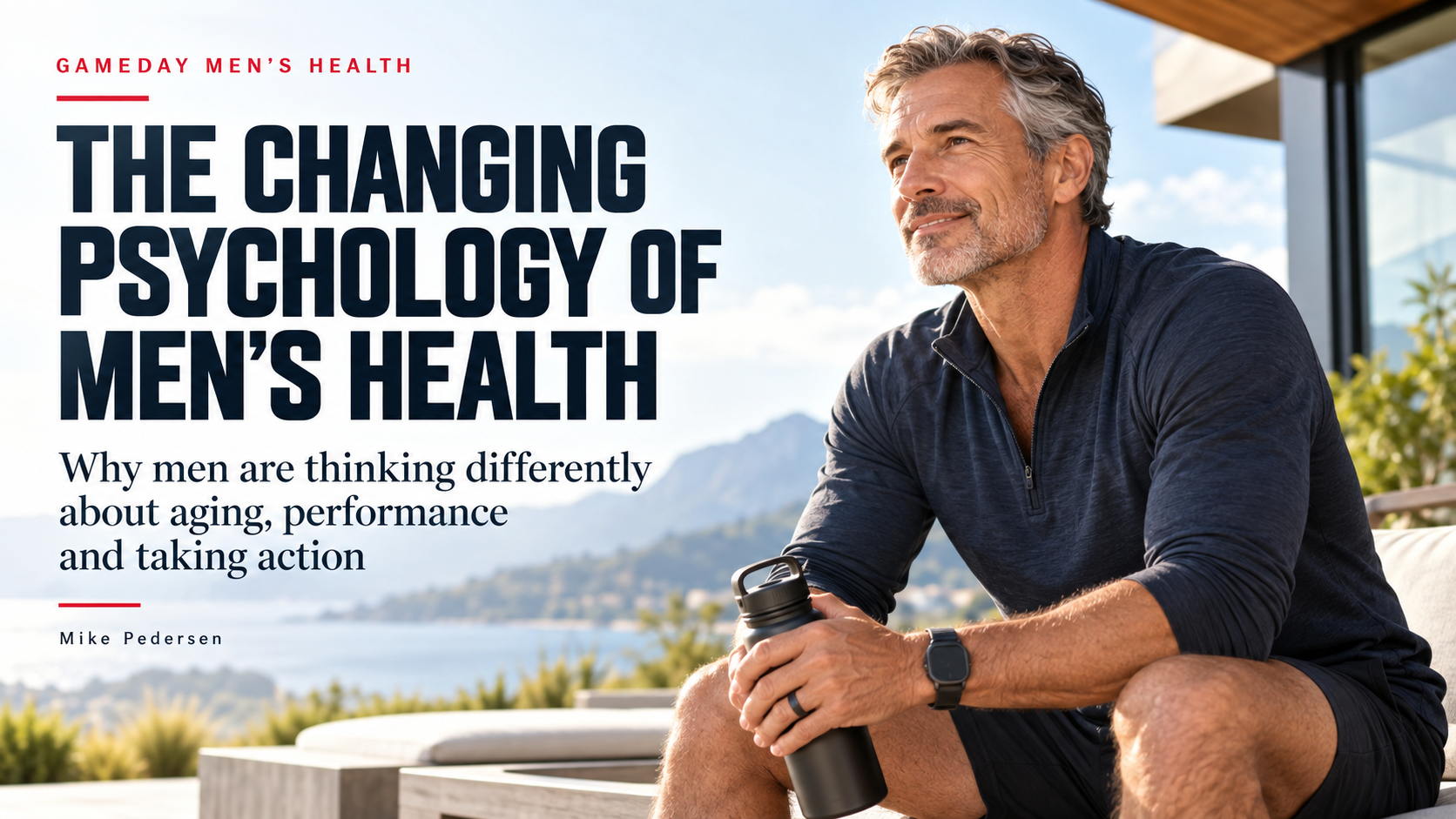
Gameday Men’s Health and the Changing Psychology of Men’s Health
For most of my adult life, I have worked around men, performance, business and change. I spent years as a trainer, built businesses, coached men through different stages of life, and eventually wrote Man Awakened because I became increasingly interested in what happens when the version of a man he has relied on for decades starts to change.
That is also why the growth of the men’s health category has caught my attention. Testosterone therapy is obviously part of the story, but I think the broader shift is much more interesting. Men are beginning to think differently about aging, performance, health, energy, sexual function, body composition and longevity. More importantly, they are beginning to question the old assumption that decline is simply something they are supposed to accept quietly.
I recently came across Gameday Men’s Health while spending more time studying this market. The company stood out because of how quickly it has expanded and because its growth appears to reflect something happening far beyond one brand. Gameday says it grew from one Southern California clinic in 2019 to more than 400 locations by 2025, while broadening its services beyond testosterone into weight management, sexual wellness, longevity and other areas of men’s health.
That kind of growth does not happen in isolation. It is occurring at the same time that men are becoming more interested in preventive health, fitness, hormone health, healthy aging and maintaining performance later in life. What interests me most is not simply the size of the market. It is the psychology underneath it.
Men Do Not Experience Aging as a Medical Checklist
Men do not usually experience aging as a tidy collection of medical symptoms. A man does not wake up one morning and think, “I am experiencing age-related physiological decline.” He notices that he does not have the same energy. His workouts feel different. Recovery takes longer. His body composition changes. His sex drive is not what it used to be. He is tired earlier in the day. His confidence may begin to shift in ways he cannot immediately explain.
Those changes are physical, but they are rarely only physical.
A man who has spent decades seeing himself as strong, capable, productive and independent can experience a change in energy or performance as something much more personal. It can challenge the picture he has of himself. The body is telling him something different from the identity he has carried for years.
That matters because identity changes behavior. When the issue feels like a threat to who a man believes himself to be, the response is not always rational or immediate. He may resist it, explain it away or simply work harder.
I have seen this pattern repeatedly. Men are often excellent at adapting. They compensate. They push through. They change routines. They add caffeine, train harder, sleep less, cut calories, ignore symptoms and convince themselves that whatever is happening is simply part of getting older.
Eventually, abnormal starts to feel normal.
The Hardest Part May Be the Space Between Recognition and Action

Gameday Men’s Health – buyer’s journey to more conversions and revenue.
This is the part of men’s health that interests me most: the period between noticing something has changed and deciding to do something about it.
That period can last weeks, months or years.
A man notices a change, looks it up online, reads a few articles, closes the browser and goes back to work. He thinks about making an appointment, then decides he is too busy. He tells himself it is stress. He assumes it will correct itself. He may not mention it to his wife or partner. He may not want to hear that something is actually wrong.
Research into men’s health repeatedly shows some version of this gap between concern and action. Cleveland Clinic’s national MENtion It research, for example, has found that men place a high value on health while still showing meaningful gaps in preventive care and help-seeking behavior.
That gap is not simply a healthcare issue. It is a behavioral one.
The distance between “something feels different” and “I am going to find out why” contains fear, pride, uncertainty, identity, embarrassment and control. For companies operating in men’s health, understanding that psychological territory is just as important as understanding the treatment itself.
Men Are Often Protecting More Than Their Health
The physical symptom is frequently connected to something larger.
Energy affects work. Strength affects confidence. Sexual function affects intimacy and self-image. Body composition affects how a man sees himself. Recovery determines whether he can continue doing the things that have always been part of his identity. Mental sharpness affects whether he still feels competitive and capable professionally.
As men get older, independence also becomes more important. The fear is not necessarily “I am getting older.” Every man knows he is getting older. The deeper concern is what getting older might eventually take away.
That is why I do not think the aspiration behind modern men’s health is accurately described as simply “staying young.” Most men in their 50s and 60s are not trying to convince themselves that they are 30.
What many of them appear to want is something different: to remain fully capable for as long as possible.
They want to remain strong enough to train. Healthy enough to travel. Energetic enough to perform at work. Confident enough to remain engaged socially and sexually. Independent enough to continue making their own decisions and living on their own terms.
That is a much more serious motivation than vanity.
Why the Men’s Health Market Is Expanding

The commercial data also point toward sustained interest in men’s wellness, healthy aging and preventive health. Market-research firms disagree on the exact size of the category, which is important to acknowledge, but multiple estimates point toward strong growth in areas such as men’s health supplements, longevity, weight management, hormone optimization and preventive wellness.
The exact market-size figure matters less to me than what men are increasingly willing to spend money to protect: energy, physical performance, body composition, sexual health, metabolic health, appearance, mobility, mental sharpness, independence and longevity.
That is a significant shift.
For much of modern healthcare, the model has been reactive. Something breaks, hurts or becomes serious enough, and then the patient seeks care. The emerging men’s health market is increasingly proactive. Men are paying attention earlier and asking different questions.
How do I maintain what I have?
Why does my body respond differently now?
What can I influence before it becomes a bigger problem?
How do I stay capable over the next 10 or 20 years?
Those questions create a much broader market than simply treating a diagnosed testosterone deficiency.
Why Gameday Men’s Health Is an Interesting Example
This is where Gameday Men’s Health becomes an interesting example rather than the subject of the entire conversation.
The company appears to understand that the traditional healthcare experience does not always fit the way men want to engage with sensitive issues involving aging, sexual health, performance and confidence. Its public positioning emphasizes a men-focused environment and a broader service mix that extends well beyond a single treatment category.
What interests me about that model is not whether every decision Gameday makes is right. I do not have access to its internal data, and I would not pretend to know what is happening inside the company.
What is interesting is what its growth represents.
A company does not scale from one location to hundreds simply because men suddenly discovered testosterone. Something larger is happening in the category. Men are more willing to engage with health when the experience, language and environment feel relevant to them.
That is where psychology matters.
The clinic may be where the medical conversation happens, but the decision starts much earlier. It starts when a man first notices that he does not feel like himself. It continues while he decides whether the issue is serious, whether it is normal, whether he trusts the category and whether taking action makes him feel proactive or vulnerable.
The companies that understand that journey are likely to have an advantage.
Health Is Becoming Part of Male Identity
Another shift I find interesting is the role health now plays in how many men define success later in life.
Traditional male status has often been external: career, title, income, home, car, watch, club membership. Those things have not disappeared, and it would be an exaggeration to claim health has somehow replaced them universally.
But there is another form of status becoming increasingly visible.
Being the 60-year-old who is still strong. Still lean. Still mentally sharp. Still working because he wants to. Still traveling. Still lifting weights. Still hiking, skiing, cycling or playing a competitive sport. Still sexually active. Still independent.
That is not merely aesthetics. It is capability.
Health becomes proof that life is still open rather than narrowing.
That idea matters commercially because it changes the emotional value of the category. Men are not necessarily paying only to fix symptoms. They may also be paying to protect identity, independence and future options.
That is a very different value proposition.
The Companies That Understand Men Will Have an Advantage
I am not a physician, and medicine is not my field. What I have spent decades studying is people, behavior, performance and decision-making.
Why people act. Why they hesitate. Why they resist information that threatens their identity. Why someone can know exactly what they should do and still not do it. Why one message creates movement while another creates nothing.
And particularly, why men who are decisive in nearly every other part of life can become remarkably good at delaying decisions about themselves.
That is why this market has my attention.
The next generation of successful men’s health companies will obviously need strong clinicians, responsible medicine, good outcomes and appropriate regulatory discipline. But they will also need to understand the man who has not become a patient yet.
The man who searched his symptoms late at night and closed the tab.
He has not told anyone he is worried.
He thinks asking for help means admitting decline.
He believes he should be able to fix it himself.
He’s spent three years explaining away something that has kept getting worse.
Understanding that man requires more than marketing. It requires understanding identity, trust, motivation and human behavior.
Why This Market Matters to Me

Men’s health brings together many of the things I have spent my career thinking about: performance, aging, identity, values, purpose, fulfillment, health, business, psychology, trust and decision-making.
That is why companies such as Gameday Men’s Health have caught my attention. The growth is interesting, but the larger cultural shift is more interesting.
Men are becoming less willing to accept decline without understanding it. They are asking more questions about how they age, what they can influence and what staying healthy actually means later in life.
The opportunity for this industry is larger than selling treatments. It is helping men engage earlier, understand what is happening and take responsibility for protecting the parts of life that matter most to them.
Gameday Men’s Health has already proven demand exists. The next advantage will come from understanding the man behind that demand better than anyone else in the category.
That means knowing what he is worried about before he searches, what makes him hesitate before he books, what builds trust before he walks through the door, and what keeps him engaged long after the first appointment.
That intersection — men’s health, buyer psychology, growth strategy, positioning and revenue — is where I do my best work.
Gameday corporate: I’m paying attention. And I believe there is a much bigger opportunity here than simply opening more clinics.
I would love to be one of your business coaches or be involved in revenue growth at the corporate level. Let’s talk!

